Beyond the Jug: What Happens When British Cooks Stop Reaching for the Gravy
There is a moment in almost every British kitchen on a Sunday afternoon where someone — usually the person who has been standing at the hob for the last forty minutes — reaches for the roasting tin and begins the familiar ritual. A splash of wine, a scrape of the fond, a heaped teaspoon of cornflour, and eventually, that glossy brown stream poured from a ceramic jug with a slightly chipped spout that has been in the family since 1987. Gravy. The great unifier. The sauce that covers everything.
France, for its part, has never really understood this.
Not because French cooks are dismissive of what comes out of a roasting tin — far from it. But the idea that one sauce might do equal justice to a leg of lamb, a rib of beef, a roast chicken, and a pork loin would strike most French home cooks as, well, a little lazy. In French culinary thinking, the sauce is not an accompaniment. It is a decision. A considered response to a specific piece of meat, a particular combination of ingredients, a deliberate flavour intention.
The Philosophy Gap
This is not about snobbery. It is about a genuinely different relationship with what ends up on the plate. Britain arrived at gravy through centuries of pragmatic, no-waste cooking — the drippings from the roast, the stock from the bones, the thickened pan juices that made a cheap cut of meat feel like a celebration. There is real beauty in that tradition, and nobody here is suggesting we abandon it entirely.
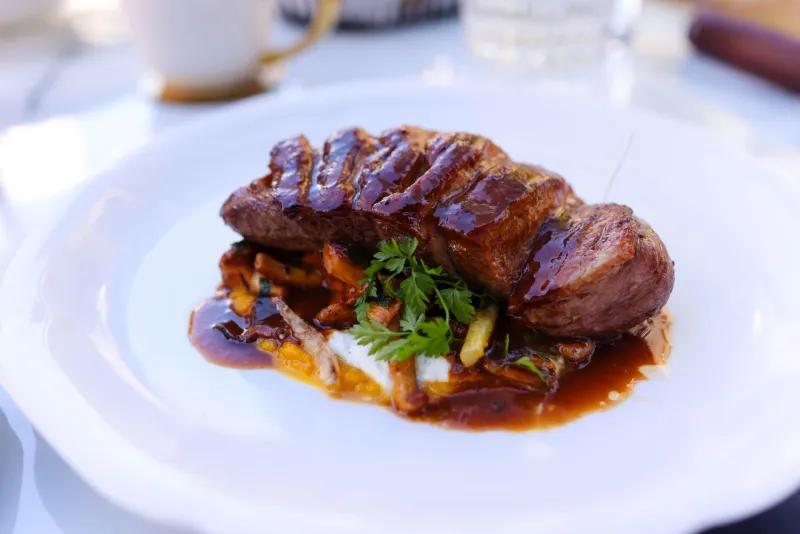
But consider what France does instead. A roast chicken — poulet rôti — might be served with a simple jus, barely thickened, intensely chickeny, finished with a little cold butter stirred in at the last moment. That is not gravy. That is the chicken itself, concentrated and clarified, poured back over the bird. A leg of lamb gets flageolet beans and their cooking liquor, or a persillade — garlic and parsley — pressed into the crust. A duck breast gets nothing heavier than its own rendered fat and a sharp, fruit-forward reduction. Each sauce is a response, not a default.
The difference is subtle but significant. Gravy says: here is something to make this moist and savoury. A French sauce says: here is something that will tell you more about what you are eating.
What We Lose at the Bottom of the Jug
Here is the uncomfortable truth. When every roast gets the same sauce — however well made — we stop tasting the individual character of the meat. A really good leg of lamb has a particular sweetness and mineral depth that deserves to be met with something that honours it. A well-rested rib of beef has a richness that actually benefits from something with a little acidity to cut through. When the gravy arrives in its jug, those distinctions start to blur.
French cooking is obsessive about what it calls accord — the harmony between a dish and its accompaniment. It is the same instinct that pairs a particular wine with a particular cheese, or insists that bouillabaisse gets rouille and nothing else. The sauce is chosen, not assumed.
This does not require a professional kitchen, a cordon bleu qualification, or three days of stock-making. It requires only the willingness to pause, briefly, before reaching for the gravy granules.
Three French Alternatives for a British Sunday Table
If you are cooking a chicken this weekend, try this: once the bird is rested and carved, pour off most of the fat from the roasting tin, add a small glass of white wine, and let it bubble fiercely for two minutes, scraping everything from the bottom. Add a ladleful of chicken stock, reduce by half, then take the pan off the heat and whisk in a generous knob of cold butter. Season. That is a jus au beurre, and it will make you wonder why you ever did anything else.
For lamb, consider a sauce vierge — not a classic pairing, but a modern French bistro favourite. Warm olive oil, chopped tomatoes, capers, lemon zest, and fresh herbs. No thickening, no stock, no hovering over the hob. It takes about five minutes and it cuts through the richness of the lamb in a way that gravy simply cannot.
For beef, try something with a little more backbone: a simple red wine reduction with shallots, a bay leaf, and a strip of orange peel. Reduce until syrupy, strain, and finish with butter. It is what a good Parisian bistro would put on the table next to your entrecôte, and it is completely achievable on a domestic hob.
The Point Is Not Perfection
None of this is an argument for abandoning the Sunday roast, or for turning your kitchen into a French restaurant. The point is something more modest: that the habit of gravy — comforting and automatic as it is — can sometimes prevent us from thinking about what a dish actually needs.
France's great contribution to home cooking is not its complexity. It is its intentionality. The willingness to ask, before you start, what this specific meal deserves. Sometimes the answer will still be a proper, glossy gravy poured from that chipped jug. But sometimes, if you pause long enough, it will be something else entirely — and that something else might just be the best thing you have ever put on a Sunday table.
The jug will still be there. You just might not need it quite as often.