Four O'Clock, on Purpose: The French Snack Ritual That Could Change How British Families Eat
Four O'Clock, on Purpose: The French Snack Ritual That Could Change How British Families Eat
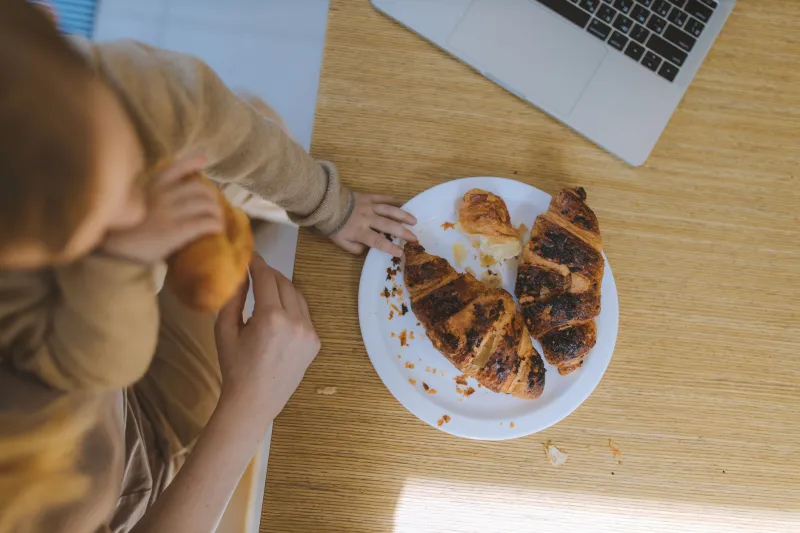
At around four o'clock on any given afternoon in France, something quietly remarkable happens. Children emerge from school and are handed something to eat. Not a cereal bar with seventeen ingredients, not a pouch of something squeezable, not a snack designed by a marketing team to appeal to parents while appealing to children even more. Usually it is a piece of bread with a square of dark chocolate tucked inside. Sometimes a slice of quatre-quarts — the French equivalent of a plain sponge — or a handful of grapes, or a small bowl of fromage blanc with a spoon of jam. Whatever it is, it is simple, it is real food, and it happens at the same time every day.
This is the goûter. And it is one of the most underappreciated French food habits there is.
What the Goûter Actually Is
The word comes from goûter, meaning to taste or to try, and the meal — if you can call it that — occupies a very specific slot in the French daily rhythm. It sits between lunch and dinner, roughly four to five hours after the midday meal, at a point when blood sugar has dropped and the evening meal is still two or three hours away. It is not a snack in the British sense, which tends to mean something grabbed opportunistically whenever hunger strikes. It is a scheduled moment, brief and uncomplicated, that acknowledges a simple biological fact: most people, particularly children, need something between lunch and supper.
In France, the goûter is treated as its own small ritual. Children sit down for it, or at least pause for it. It is not eaten in transit, not consumed in front of a screen as a distraction, not a reward for good behaviour or a consolation for bad weather. It is simply the four o'clock thing, as reliable as the school run itself.
Adults observe their own version. A coffee and a biscuit, perhaps. A slice of something left over from the weekend's baking. A piece of fruit taken seriously, at a table, with a moment's attention. The French have a phrase — la pause goûter — which implies not just the eating but the stopping. The deliberate interruption of the afternoon.
Why Britain Struggles with This
British snack culture is, by contrast, almost entirely reactive. We eat when we are hungry, when we are bored, when we walk past a shop that smells interesting, when someone puts a biscuit tin on the desk at work. The snack industry has spent decades and considerable sums of money ensuring that hunger is never more than arm's reach from a solution — and that solution is almost always packaged, processed, and engineered to be slightly more appealing than it has any right to be.
The result is a kind of low-level, continuous grazing that never quite satisfies and never quite stops. British children, in particular, often arrive at the dinner table having already consumed a steady drip of snacks since school ended — and then wonder why they are not especially hungry. Parents, understandably, find this maddening.
The problem is not that British families snack. It is that the snacking is shapeless. There is no goûter moment, no designated time, no particular food that belongs to it. Everything is available always, and so nothing carries any particular significance.
The Radical Simplicity of Bread and Chocolate
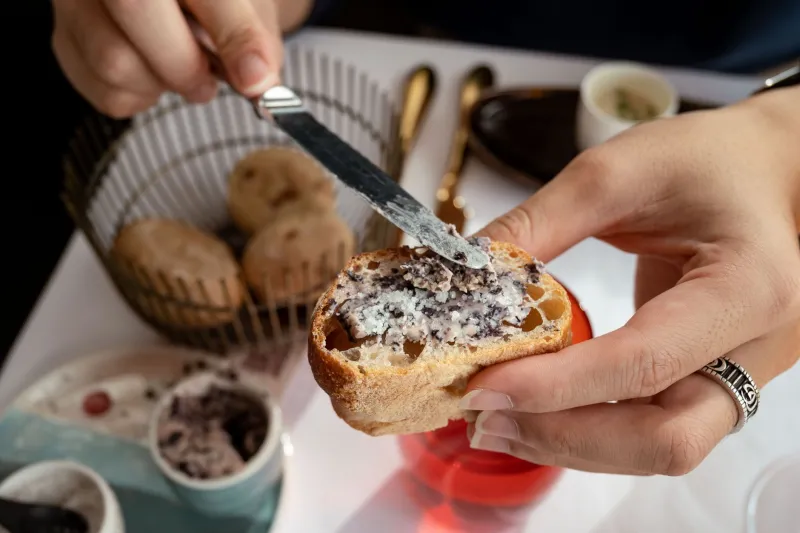
The most classic goûter — a piece of baguette with a square of dark chocolate — is worth examining in some detail, because it is almost aggressively simple. There is no recipe. There is no preparation. You break off a piece of bread, you put a piece of chocolate on it or inside it, and you eat it. That is the whole thing.
And yet it works, in a way that a chocolate biscuit or a cereal bar does not quite manage to replicate. The bread provides substance. The chocolate provides pleasure. Together they are satisfying without being excessive, and the simplicity of the combination means the experience is over in a few minutes rather than escalating into a second packet and then a third.
There is also something important about the use of real ingredients — proper bread, proper chocolate — rather than processed approximations. The goûter does not pretend to be a health food, but it is made of actual things, and that matters more than it might seem.
Building a British Goûter
Adopting the goûter habit in a British household does not require a cultural transplant. It requires, mostly, a decision about timing and a small amount of advance thought.
Choose a time — four o'clock is the traditional slot, but half past three works just as well for children who have been at school since eight in the morning. Make it consistent. The predictability is part of the point; knowing that something is coming at a fixed time reduces the low-level hunger anxiety that drives most mindless snacking.
Keep it simple. A slice of good bread with butter and jam. A small bowl of yoghurt with fruit. A few squares of chocolate alongside a handful of nuts. A piece of proper cake — not a processed snack cake, but something baked, even if it came from the supermarket bakery section. The French goûter is not elaborate. Its virtue is in its regularity and its realness.
For adults, the pause goûter is an opportunity to step away from the desk or the kitchen for ten minutes with a coffee and something small to eat. The French understanding that this break is legitimate — not indulgent, not a sign of weak willpower, but a sensible acknowledgement of how afternoons actually feel — is itself worth borrowing.
The Bigger Picture
The goûter is, in miniature, a demonstration of the French approach to eating more broadly: that meals and snacks are not interruptions to real life but are themselves part of the rhythm of a well-organised day. By giving the afternoon snack a name, a time, and a modest set of conventions, France transforms it from a moment of weakness into a moment of pleasure. That distinction — small as it sounds — has a surprisingly large effect on how the rest of the day's eating goes.
British families who have tried building a consistent goûter moment into their afternoon often report the same thing: children arrive at dinner actually hungry, evening grazing reduces, and the four o'clock slot becomes something everyone looks forward to rather than something that happens by accident.
It is, in the end, just a piece of bread and a bit of chocolate. But done deliberately, at the same time every day, it is also something else: a small, French proof that the way we structure eating matters just as much as what we eat.