The Knife Is the Thing: Why French Cooks Learn This First and British Cooks Learn It Last
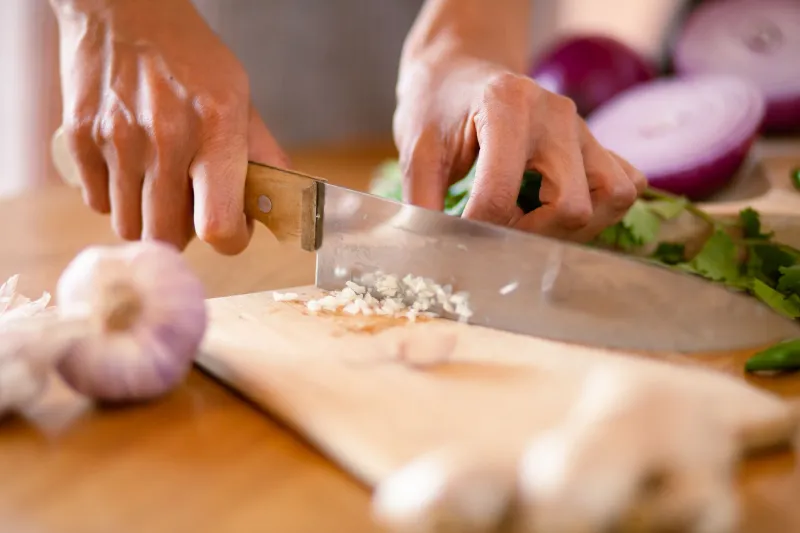
Before the sauce. Before the seasoning. Before any conversation about technique, timing, or the correct fat to cook in — there is the knife. In French culinary tradition, everything begins there. The ability to break down an onion cleanly, to julienne a carrot with consistency, to work a board efficiently and without drama: these aren't skills reserved for professional kitchens. They're considered basic adult competencies, the kind of thing a French parent teaches a child alongside how to set a proper table.
In Britain, we've taken a different path. We've largely taught ourselves — from YouTube tutorials, from watching chefs on television, from years of muddling through with whatever knife came in the block from a department store — and the results, if we're honest, are mixed. Most British home cooks chop the way they were never taught not to: knuckles exposed, blade at odd angles, onions rolling across the board with alarming unpredictability.
This isn't a small thing. The knife is the single most-used tool in any kitchen. Getting it wrong — or more precisely, never getting it right — costs time, wastes food, and makes cooking harder and less enjoyable than it needs to be.
What Mise en Place Actually Means
The French concept of mise en place — literally, "everything in its place" — is one of those culinary phrases that has been borrowed so often it's lost some of its meaning. In professional kitchens, it refers to the entire system of preparation that happens before service: stocks reduced, sauces made, vegetables prepped, everything measured and ready.
But at its most fundamental level, mise en place is a philosophy about the relationship between preparation and cooking. The idea is simple: if your prep is done properly, the cooking itself becomes calm, controlled, and almost effortless. If your prep is chaotic — if you're still hacking at a shallot while your butter is burning — the whole enterprise unravels.
French home cooks absorb this philosophy early. The mise en place mindset means that before the heat goes on, you've thought through what you need, prepared it properly, and arranged it so the cooking flows. British cooking culture tends to skip this step, diving straight into the pan and improvising the prep around the chaos. It works, after a fashion. But it's harder than it needs to be.
The Grip Nobody Taught You
Let's start with the most practical intervention possible: how to actually hold the knife.
The pinch grip — where your thumb and index finger pinch the blade itself, just above the bolster, with the remaining fingers wrapped around the handle — gives you control, reduces fatigue, and dramatically improves precision. Most British home cooks hold the handle entirely, which puts the control point too far from the blade and makes accurate cuts much harder.
It feels strange for about three minutes. After that, it feels like the only sensible option, and you'll wonder why nobody mentioned it sooner.
The second adjustment is the guiding hand. The "claw" position — fingertips curled under, knuckles forward, acting as a guide for the blade — is what prevents accidents and enables consistent cuts. It keeps your fingers safe and gives the knife a straight edge to run against. Without it, you're eyeballing every cut and hoping for the best.
Neither of these things requires a course, a YouTube subscription, or any special equipment. They just require someone to tell you, which is what happens in France and, historically, hasn't much happened here.
Why Consistent Cuts Actually Matter
This isn't about aesthetics, though there is something genuinely satisfying about a pile of evenly diced onion. Consistent cuts matter because food cooks evenly when the pieces are the same size. A stew with roughly torn carrots and unevenly chunked potato will have some pieces overcooked and others underdone. The same stew with properly cut vegetables cooks uniformly, tastes better, and requires less anxious poking and checking.
The brunoise — tiny, precise cubes, around two to three millimetres — is the cut that makes French sauces and soups taste the way they do. It's not magic. It's geometry. When aromatics are cut that small, they dissolve into the background of a dish, contributing flavour without texture, building depth without dominating. You can approximate it with rough chopping. But you can't replicate it.
Where to Actually Start
You don't need a professional knife skills class, though they exist and they're worth doing if the opportunity arises. What you need is a decent knife — one good chef's knife, properly sharpened, will outperform a block of mediocre ones — and a bit of deliberate practice.
Start with the onion. It's the most-chopped vegetable in most kitchens, and it's the one where poor technique costs the most time. Learn the French method: halve through the root, make horizontal cuts towards the root without cutting through it, make vertical cuts down towards the board, then slice across. The result is an evenly diced onion in about thirty seconds, with no rolling, no chasing, no tears beyond the unavoidable ones.
Then move to the carrot. Practice julienne — thin matchsticks — by squaring off the carrot first to create flat surfaces, then slicing into planks, then cutting across into strips. It's methodical, almost meditative once you get the hang of it, and the results look and cook nothing like the rough batons most of us produce by default.
The Practical Payoff
Here's the honest case for investing in this: it makes cooking faster, calmer, and more enjoyable. When your prep is efficient, you spend less time in the stressful gap between starting a recipe and actually cooking it. You waste less food because your cuts are deliberate rather than approximate. And the finished dishes taste better because the fundamentals were done properly.
French cooking isn't mysterious. It isn't inherently more complicated than British cooking. But it does begin with a seriousness about preparation that we've never quite built into our domestic food culture. The knife is where that seriousness starts. Pick one up properly, and everything else follows.