The Market Basket You're Not Filling: French Vegetables That British Cooks Keep Walking Past
The British supermarket vegetable aisle has, in fairness, improved enormously over the past twenty years. There's heritage tomatoes now, and cavolo nero, and at least three varieties of squash in autumn. Progress has been made.
But walk through a covered market in Bordeaux or Lyon in November and you'll find an entirely different conversation happening. Gnarly black radishes the size of a fist. Pale, tapered salsify roots. Celeriac like a muddy moon. Frisée in loose, wild-looking heads. Cardoons, scorzonera, mâche by the basketful. This is the vegetable vocabulary of French bistro cooking — the ingredients that give the cuisine its quiet depth and its seasonal honesty — and most British cooks have barely a word of it.
This isn't about difficulty. These vegetables don't require specialist techniques or obscure equipment. They require only a willingness to pick them up, take them home, and cook them with the same confidence you'd bring to a parsnip. Which is, essentially, all they ask.
Celeriac: The Ugly Root with Impeccable Manners
If you've eaten céleri rémoulade at any French bistro worth its salt, you've already met celeriac at its most charming. The dish — raw celeriac, finely julienned, dressed in a mustardy mayonnaise — is one of those French classics that looks simple and tastes like it took effort. It takes about fifteen minutes and costs very little.
But celeriac is equally useful cooked. Roasted in wedges with olive oil and thyme, it develops a nutty sweetness that puts ordinary roasted root vegetables to shame. Puréed with butter and a little cream, it's one of the best things you can put under a piece of pan-fried fish. Simmered in a gratin with potato and a splash of cream, it adds an earthiness that transforms the dish entirely.
In Britain, celeriac appears sporadically at farm shops and better supermarkets from autumn through winter. Abel & Cole and Riverford both carry it regularly in their vegetable boxes. It looks alarming — all knobbled exterior and tangled roots — but once you've peeled away the outer layer (a sturdy vegetable peeler does it, though a small knife helps with the deeper crevices), what's inside is clean, white, and cooperative.
Salsify: The Vegetable That Tastes Like the Sea
Salsify is the one that tends to genuinely surprise people. It's a long, thin root, beige-skinned and unremarkable-looking, but it has a flavour that's genuinely distinctive — faintly sweet, with an oceanic quality that's earned it the nickname oyster plant in some French cookbooks.
French cooks typically cook it simply: peeled, cut into batons, simmered until tender, then finished in butter with a little lemon and parsley. That's really all it needs. The butter amplifies the sweetness, the lemon lifts it, and the parsley keeps it honest. It works beautifully alongside white fish or roast chicken.
Finding salsify in Britain takes a little more effort than celeriac. Specialist greengrocers and farmers' markets are your best bet; the growing number of Continental-style delis in UK cities often stock it through winter. Some of the better farm box schemes carry it intermittently. It's worth seeking out.
One practical note: salsify oxidises quickly once peeled, turning greyish if left exposed to air. Drop the peeled roots into acidulated water — a bowl of cold water with a squeeze of lemon — as you go, and you'll have no problems.
Black Radish: The Winter Condiment You Didn't Know You Needed
The black radish (radis noir in French) looks like something from a fairy tale — round, jet-black on the outside, startlingly white within, with a flavour that's fiercer and more complex than the pink breakfast radishes most British cooks know. It's peppery, slightly bitter, and deeply savoury in a way that makes it extraordinarily useful.
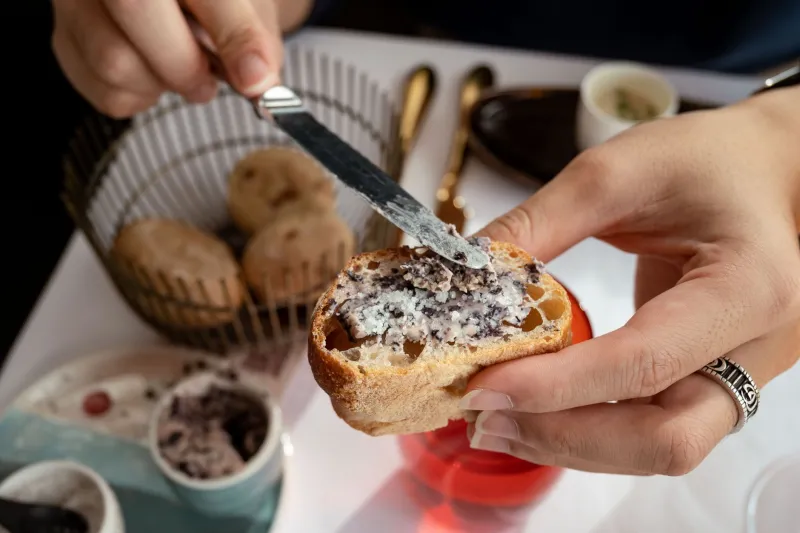
In France, it's often eaten raw, very thinly sliced, with good butter and a pinch of fleur de sel. This sounds too simple to be interesting and is, in fact, one of the best things you can put on a piece of bread. The heat of the radish, the fat of the butter, the salt — it's a combination that makes complete sense the moment you try it.
Cooked, black radish mellows considerably. Braised slowly in a little stock and butter, it becomes almost sweet, making it a surprisingly good companion to rich meats. Grated raw into a winter slaw with apple, walnut, and a mustardy dressing, it adds backbone and bite that keeps the whole thing lively.
Black radishes are available at many Asian supermarkets in the UK (they're used across East Asian cuisines as well as French ones), at some farmers' markets, and occasionally at larger Waitrose or Whole Foods branches in autumn and winter.
Frisée: The Salad That Knows What It's Doing
Frisée — the pale, curly-leaved chicory that appears in every salade lyonnaise — is not simply a lettuce. It has opinions. It's bitter, it's robust, it holds its texture under a warm dressing in a way that soft lettuce leaves simply can't, and it has a structural integrity that makes it feel like a proper ingredient rather than a backdrop.
The classic French preparation is the one worth learning first: frisée dressed with a warm vinaigrette made from the rendered fat of lardons, a splash of red wine vinegar, and a little Dijon. Topped with a poached egg. Eaten immediately, while the egg is still runny and the leaves are just slightly wilted at the edges. This is bistro cooking at its most elemental and most satisfying.
Beyond the lyonnaise, frisée works brilliantly in any salad where you want some assertiveness — paired with blue cheese and walnuts, with roasted beetroot and goat's curd, with anchovy-dressed croutons. It's a leaf that pushes back, which is exactly what a winter salad needs.
Frisée is more widely available in Britain than it used to be. Most supermarkets carry it, though the quality varies. Look for heads with plenty of pale, almost white inner leaves — these are the most tender and least bitter parts.
The Broader Point
None of these vegetables require a culinary conversion or a trip to a specialist supplier in London. They require, mostly, a shift in habit — a willingness to pick up something unfamiliar at the market and trust that a little butter, a little salt, and a little curiosity will get you most of the way there.
French bistro cooking has always understood that the quality of the ingredient does most of the work. You don't need a complex technique to make celeriac taste extraordinary. You need a good celeriac, a hot pan, and enough confidence to let it get properly golden before you turn it.
The vegetables are there. They've been there all along, waiting on the stall at the end of the market while everyone queues for the cherry tomatoes. Go and pick one up. Take it home. See what happens.