The Last Thirty Seconds: What French Cooks Do to a Plate That British Cooks Skip
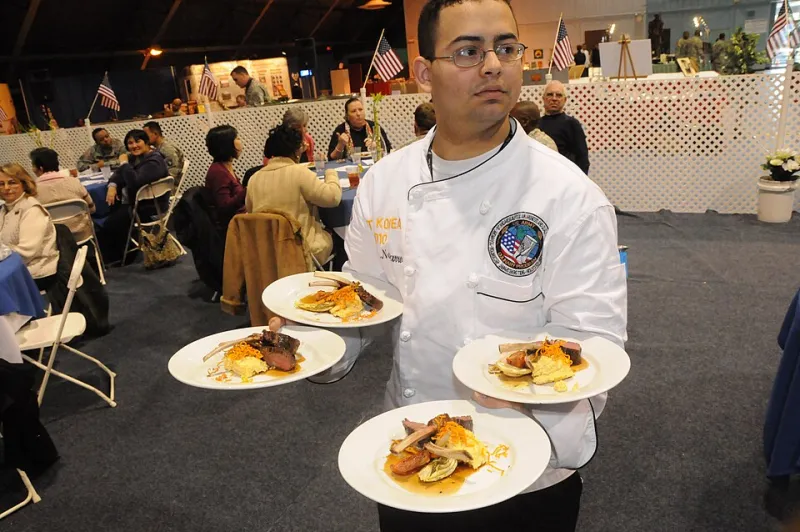
Photo: US Army Africa, CC BY 2.0, via Wikimedia Commons
I want to make a slightly uncomfortable argument: most British home cooking is unfinished.
Not undercooked. Not badly seasoned. Not carelessly made. Unfinished in the specific sense that it stops one step short of what it could be. The food reaches the plate and the cook considers the job done. In France, that same moment — food on plate, plate on counter — is the beginning of a brief but essential final act. And the difference between those two approaches is, I'd argue, the single most overlooked gap in British home cooking.
What 'Finishing' Actually Means
Professional kitchens have a concept called the 'pass' — the moment where a dish is completed before it leaves the kitchen. At the pass, even in modest restaurants, there is always a final check. Not just for temperature or presentation, but for what chefs call balance. Does this dish have contrast? Acid against fat? Crunch against softness? Something bright against something deep? Is the last taste — the one that lingers after the first forkful — the right one?
French home cooks absorb a version of this thinking without ever calling it by name. It's the instinct that reaches for the lemon before a plate of fish goes to the table. The habit of scattering fresh herbs over a finished braise. The reflex to add a tiny pour of good olive oil over a bowl of soup just before serving, not for flavour exactly but for the way it changes the texture of every spoonful.
These aren't decorative gestures. They're functional ones. And British cooking, which has an admirable tradition of honest, robust food, tends to skip them almost entirely.
Why British Plates Look Right but Taste Flat
Here's a generalisation worth making: British food often looks complete. The portion is generous. The components are all present. The plate is tidy. But there's a flatness to the experience — a sense that everything is happening at the same volume, in the same register, without the little flickers of contrast that make eating genuinely interesting.
French cooking, even at its most rustic, tends to have at least one element of deliberate contrast on the plate. A scattering of something sharp or acidic. A textural note — something crisp on something yielding. A garnish that isn't decorative but flavourful. A finish that changes the temperature or brightness of the dish in the final moment.
This isn't about cheffy fussiness. A simple bowl of lentil soup finished with a swirl of crème fraîche and a few leaves of flat-leaf parsley is still a simple bowl of lentil soup. But it's one that has been thought about all the way to the end, rather than abandoned at the moment the cooking stopped.
The Techniques Worth Stealing
Let's make this concrete, because finishing is genuinely learnable and the techniques are not complicated.
Acid at the end. A squeeze of lemon or a small splash of good wine vinegar added to a finished dish — not during cooking, but at the very end — lifts everything. Fat-heavy dishes especially: roast chicken, braised pork, anything rich and slow-cooked. The acid doesn't make the dish taste lemony. It makes it taste more like itself. This is the single most transformative finishing habit you can develop.
A fat finish. A small pour of good olive oil over roasted vegetables or grilled fish just before serving. A knob of cold butter swirled into a sauce off the heat. These additions change the mouthfeel of a dish in the final moment, adding richness and gloss that cooking alone can't produce. The French call the butter version 'monter au beurre' — mounting with butter — and it is one of the great small techniques in cooking.
Textural contrast. Something crunchy on something soft. Toasted breadcrumbs over a creamy gratin. A handful of roughly chopped toasted hazelnuts over a salad of wilted greens. Pan-fried capers scattered over a piece of salmon. The crunch isn't there to be impressive — it's there because the mouth needs variation. Without it, eating becomes monotonous in a way we feel but can't always name.
Fresh herbs, added last. Not cooked in, but scattered over at the final moment. Tarragon over chicken. Chervil over eggs. Flat-leaf parsley over almost anything. Fresh herbs added during cooking lose their brightness and become part of the background. Fresh herbs added at the end remain vivid — they taste of themselves, which is the point.
The temperature trick. Something cold or cool against something hot. A spoonful of cold crème fraîche on a warm bowl of soup. A small amount of dressed raw salad alongside something just out of the oven. The temperature contrast wakes up the palate in a way that a uniformly hot plate never does.
The Philosophy Behind the Practice
I think the reason British cooks skip the finishing step is partly cultural and partly structural. Culturally, there's a tradition of not fussing — of letting the food speak for itself, of treating additional steps as affectation. This is an admirable instinct in some respects. But it has calcified into an assumption that the cooking is the whole job, when in fact the cooking is most of the job.
Structurally, recipe culture doesn't help. Most recipes end at 'serve immediately' without ever explaining what serving actually involves. The finishing step is either omitted entirely or buried in a vague instruction to 'garnish with parsley' — a phrase so devoid of meaning that it might as well not be there.
French cooking passes on finishing instincts through observation. You watch someone cook and you see them reach for the lemon at the end. You see them pause before the plate goes out and add something — a thread of oil, a pinch of fleur de sel, a few leaves of something green. You absorb the habit before you understand the reason for it.
British cooking, increasingly learned from books and screens rather than from watching other people cook, loses that transmission. The habit never forms because it was never witnessed.
Making It Yours
You don't need to overhaul your cooking to adopt a finishing practice. You need to add thirty seconds to the end of every meal you make.
Before the plate goes to the table, stop. Look at it. Ask yourself: what is this dish missing? Is it brightness? Add acid. Is it richness? Add fat. Is it texture? Add crunch. Is it colour and freshness? Add herbs. Is it seasoning? Add salt — but at the table, not in the pan, so it stays on the surface and hits the tongue first.
This is the discipline. Not a set of rules but a habit of attention — the same attention that French cooks bring to every plate, in every kitchen, however modest the meal.
The food doesn't need to be complicated. It just needs to be finished.