Cloth, Not an Afterthought: What the Humble Napkin Reveals About How France and Britain Think About Sitting Down to Eat
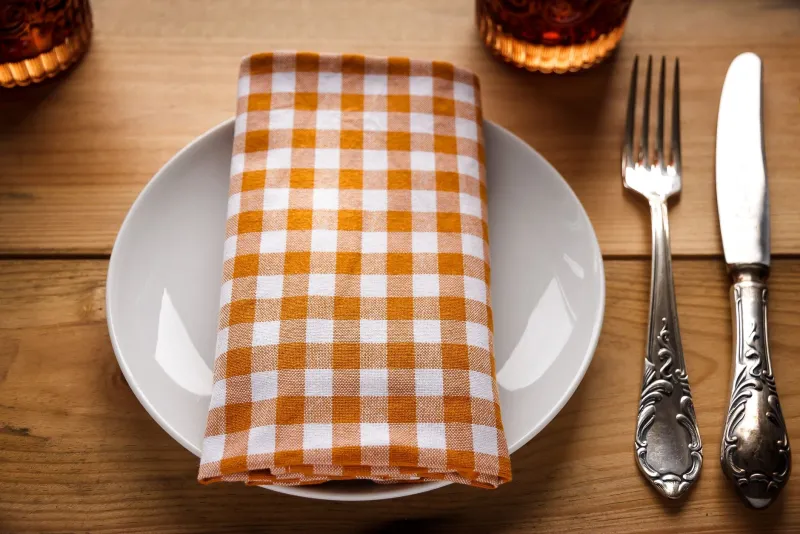
There is a moment, in any decent French café or bistro, that happens before the bread arrives, before the wine list appears, before anyone has said a word about what they'd like to eat. A waiter — unhurried, deliberate — lifts the folded napkin from the table and places it across your lap. It is not a flourish. It is not theatre. It is simply the signal that something is beginning, and that beginning deserves a little ceremony.
In Britain, the napkin tends to arrive differently. Sometimes it's already on the table, folded into a rough triangle, tucked beneath a fork like a forgotten afterthought. Sometimes it's paper, dispensed from a chrome holder on the table's edge. Sometimes it doesn't arrive at all until you've already dripped something on your shirt. The contrast isn't about snobbery. It's about intent.
The Fold Has a History
The French relationship with the table napkin — la serviette de table — goes back centuries, and not merely as a symbol of upper-class etiquette. In an era before running water made laundry trivial, a cloth napkin was a practical, valued object. You treated it with care because replacing it was expensive. You folded it because folding preserved it. You kept it across your lap because that's where it was useful.
Over time, that practicality became ritual. The fold became a signal of respect — not for the napkin itself, but for the table, the food, and the people sharing both. French domestic culture absorbed these habits into ordinary life. Schoolchildren in France are still taught the basics of table comportment, not as a lesson in stuffiness, but as an extension of the same respect you'd show a guest in your home.
Britain had its own napkin traditions, of course. The Victorians were obsessed with elaborate folds — swans, bishops' mitres, fans. But somewhere between the post-war era's embrace of informality and the modern restaurant's race toward casual dining, the napkin got demoted. It became functional at best, decorative at worst, and entirely optional in far too many places.
What the French Actually Do
The standard French bistro napkin technique is almost comically simple, which makes Britain's abandonment of it all the more puzzling. You sit. You unfold the napkin. You place it across your lap, folded in half so the open edge faces away from you. When you leave the table briefly, you fold it loosely and place it to the left of your plate — not screwed into a ball, not draped over the chair like a defeated flag. When the meal ends, you leave it loosely folded beside your plate. That's it. No origami required.
The logic behind each step is worth noting. The napkin stays on your lap because that's where spills happen. The fold keeps it in place and doubles the fabric's coverage. The temporary placement to the left — rather than on your chair — is both hygienic and considerate to the staff who have to handle it. These aren't arbitrary rules. They're solutions to practical problems, dressed up in habit until they became second nature.
French home cooks take this further still. Many households use ronds de serviette — napkin rings — so that each family member's napkin can be reused across several meals. It's an act of frugality dressed as ritual, which is very French: making the sensible thing feel elegant.
Why Britain Drifted Away
The British retreat from table formality is understandable, up to a point. Post-war culture rightly questioned the class associations baked into formal dining. The rise of casual restaurant formats — the gastropub, the fast-casual chain, the flat-white-and-sourdough café — made stiffness seem not just unnecessary but actively unwelcoming. Informality became a virtue.
But somewhere along the way, informality curdled into indifference. Abandoning the napkin ring is one thing. Replacing the cloth napkin with a paper square the size of a playing card is another. The paper napkin, for all its convenience, does something subtly corrosive to the atmosphere of a meal: it tells the diner that the table hasn't been fully prepared for them. That their presence wasn't anticipated with any particular care.
This isn't about expense. A decent set of cotton napkins costs less than a round of cocktails. The issue is philosophical. If the meal is just fuel — something to be consumed efficiently and cleared away — then a paper square is perfectly adequate. If the meal is an occasion, however modest, then the cloth napkin is part of making it feel like one.
Formality Without Fussiness
The French model is worth studying precisely because it isn't stiff. Walk into a busy Parisian brasserie at noon and you'll see businesspeople, students, elderly couples, and tourists all sharing the same space, all using cloth napkins, none of them feeling remotely oppressed by the fact. The napkin isn't a class marker there. It's just part of how lunch works.
That's the version Britain could borrow. Not the Victorian swan fold. Not the white-gloved formality of a three-Michelin-star dining room. Just the quiet acknowledgement that a meal is an event, however brief, and that the table should reflect that.
At Le Café Anglais, the napkin goes on your lap before the menu arrives. It's cloth. It's folded in half. Nobody makes a speech about it. But it sets a tone — one that says: you're not just here to eat. You're here to sit down properly, take a breath, and let something genuinely good happen.
The Small Gesture That Changes Everything
Table manners get a bad press in Britain because they're so often associated with the wrong things: privilege, judgment, the anxiety of using the wrong fork. But the best French table habits aren't about judgment at all. They're about attention. The napkin on the lap is a physical act of arriving at the table — of saying, with your hands, that you're here now and you intend to be present.
That's not a French thing, really. It's just a human thing. And it costs nothing but a moment of intention, which is precisely the kind of thing a good meal deserves.