Eating While Walking Is Not a Meal: What France Understands About Food That Britain Has Forgotten
There's a particular kind of British lunch that most of us know intimately. A triangular sandwich from a meal deal, eaten at a desk with one hand while the other scrolls through emails. Or a pastry consumed in four bites on the way to a meeting, wrapper still in hand when you push through the door. We've become so accustomed to this that we barely notice it anymore. It's just lunch. It's just how things are.
In France, it isn't. And the gap between those two realities is worth examining properly — not to romanticise the French or to pile more guilt onto already overstretched British workers, but because the French position on eating-on-the-move is rooted in something more practical than cultural superiority. It's rooted in the understanding that food only works if you actually stop for it.
The Pavement Pasty Problem
Walk through any British city centre at noon on a Wednesday and you'll see it everywhere: people eating standing up, eating walking, eating hunched over a low wall, eating in their cars. The food itself is often perfectly decent — a good sausage roll, a reasonable wrap, a soup from a cardboard cup. But the act of eating has been entirely stripped of context. There's no table. No pause. No transition between the working world and the eating world. Just calories, consumed as efficiently as possible so we can get back to whatever we were doing.
France resists this, and it resists it culturally rather than legally. You won't be arrested for eating a baguette on the Métro, but you will feel the mild social disapproval of everyone around you. Eating in public, while moving, is considered slightly — well, odd. Not catastrophically rude, but certainly not the done thing. The French lunch break, even in its abbreviated weekday form, generally involves a chair. A table. A proper plate, or at minimum a tray. The act of eating is separated from the act of everything else.
It's Not Snobbery. It's Physiology.
Here's where it gets interesting, because the French aren't doing this out of some abstract commitment to elegance. They're doing it — whether consciously or not — because it works better. When you sit down, you slow down. When you slow down, you actually taste what you're eating. When you taste what you're eating, satiety signals have time to register. When satiety signals register, you don't overeat. When you don't overeat, you don't spend the rest of the afternoon in that grim fog of too-much-too-fast.
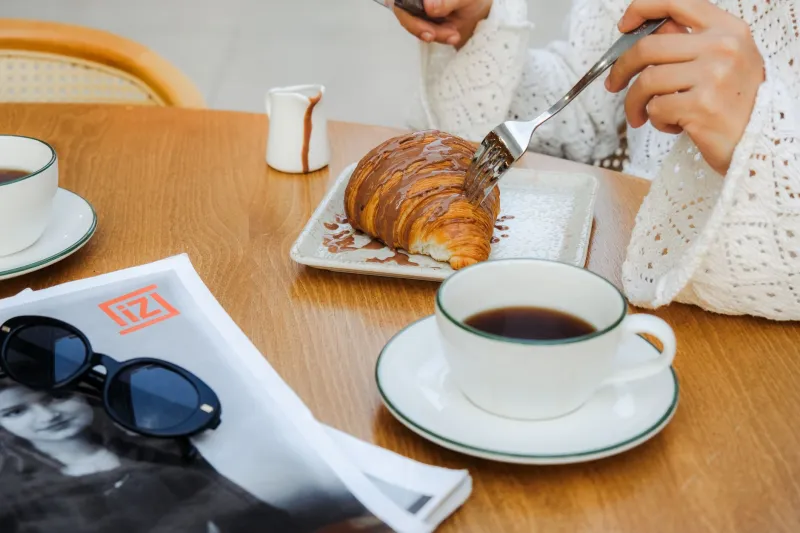
Digestively speaking, eating while stressed or distracted — rushing between meetings, scrolling, standing — is genuinely counterproductive. The body can't prioritise digestion when it's in motion or under cognitive load. The meal deal consumed at a keyboard is technically food, but the body is only half-processing it. The French café lunch — even a modest one, even a simple croque-monsieur and a coffee — eaten while seated and not looking at a screen — is nutritionally and physiologically a different experience, even if the calorie count is similar.
What We've Traded Away
Beyond the physical, there's the social dimension. The French midday meal, at its best, is a brief but genuine social act. Colleagues go together. Conversations happen. The morning is briefly set aside. This isn't inefficiency — it's the kind of mid-day reset that makes the afternoon actually function. French productivity researchers have noted for years that the culture of proper lunch breaks doesn't hurt output. If anything, the cognitive refresh it provides makes the hours that follow sharper.
Britain, by contrast, has absorbed the American model of desk-eating as a virtue. The person who eats lunch at their desk is seen, somewhere in our cultural subconscious, as more committed, more hardworking, more serious. We've turned the abandonment of a basic human pleasure into a professional credential. It's a deeply strange thing when you hold it up to the light.
And then there's the relationship with food itself. When eating is always functional — fuel for the next task — it becomes harder to develop any genuine engagement with what you're eating. You stop noticing. You stop caring. And when you stop caring about food, you stop cooking properly, stop shopping thoughtfully, stop expecting anything from the experience beyond a temporary absence of hunger. That's a significant loss, and it compounds over time.
Small Rebellions, Realistic Ones
Nobody is suggesting that every British office worker needs to find a linen-covered table and two hours for a three-course lunch. That's not the world most of us inhabit. But there are realistic, genuinely achievable ways to reclaim some of what's been lost.
The simplest is also the most radical: sit down. Even if it's a sandwich from the supermarket. Even if it's fifteen minutes. Find a surface that isn't your desk, put the food on it, and eat it without looking at your phone. That's it. That's the whole intervention. It sounds almost embarrassingly minor, and yet for many people it would represent a genuine change in daily habit.
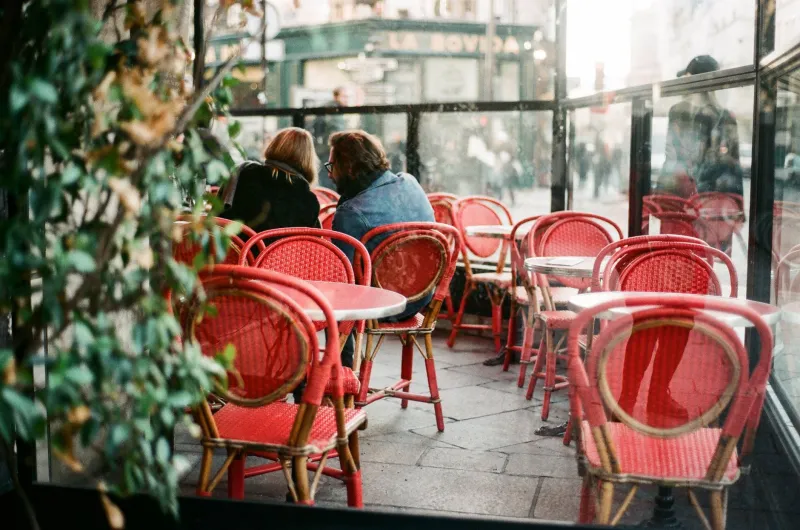
For those who have more flexibility, the French model of a proper midday meal — cooked or bought but eaten properly — is worth experimenting with even once or twice a week. Le Café Anglais exists precisely because the French café experience isn't alien to Britain; it's just underused. A bowl of soup and some bread at an actual table, in the middle of the day, is not a luxury. It's a recalibration.
 Photo: Le Café Anglais, via i.pinimg.com
The Sit-Down Moment
What France understands — and what Britain has largely traded away in the name of efficiency — is that the moment of sitting down to eat is not incidental to the meal. It is the meal. The table, the pause, the act of deliberately stopping — these aren't decorative extras. They're the frame that makes the food meaningful.
Grab-and-go eating isn't just a logistical choice. It's a philosophical one, and it carries consequences: for how we feel in the afternoon, for how we relate to food, for how we connect with the people around us. France hasn't got everything right. But on this particular point, the insistence on sitting down — even briefly, even modestly — is not a cultural quirk. It's a quiet wisdom that Britain would do well to borrow.