Cheese in the Middle: The French Habit That Will Change How You Think About Every Meal
Let's address the peculiarity head-on. In France, the cheese board arrives before dessert. Not as an alternative to it. Not instead of it. Before it — as a distinct course in its own right, positioned between the main and the sweet. If you've ever sat down to a proper French meal and found yourself slightly disoriented by this sequencing, you're not alone. Most British diners encounter it with mild confusion and assume it must be a regional quirk, or perhaps a mistake.
It isn't. It's one of the most considered decisions in all of French culinary culture. And once you understand the logic, the British habit of wheeling out the cheese after pudding starts to look rather like putting on your coat before your trousers.
The Logic of Where Cheese Sits
The French meal is built on a principle of progression — a deliberate movement through flavour registers that mirrors a kind of narrative arc. Savoury to richer savoury. Complexity to sweetness. The palate is treated as something that needs guiding, not overwhelming.
Cheese, in this architecture, functions as a bridge. After a main course — typically something substantial, perhaps a braise, a roast, or a fish in a butter sauce — the palate sits in a savoury, umami-rich register. Moving directly from that into a sweet dessert is a significant tonal leap. Cheese, placed between the two, softens the transition. It extends the savoury experience just long enough to make the sweetness of dessert feel earned rather than jarring.
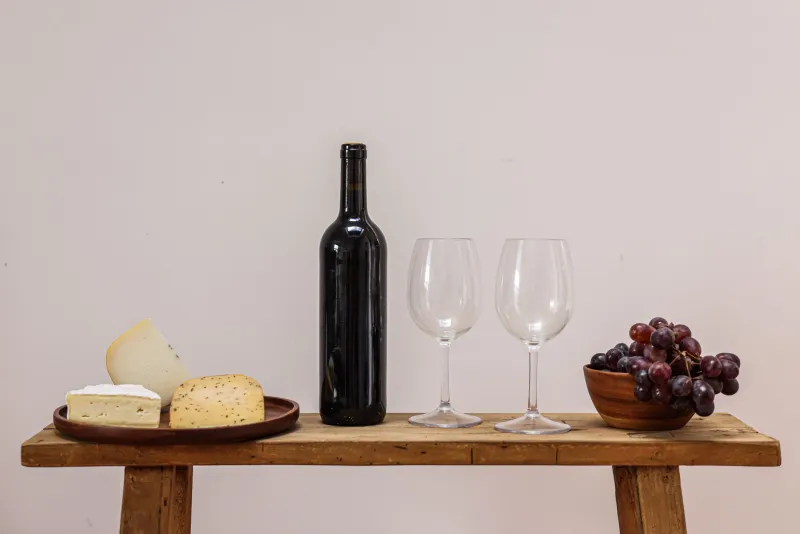
There's also a practical dimension. A cheese course served before dessert is accompanied by the tail end of the red wine, which still sits in the glass from the main. The pairing is natural, uncontrived, and delicious. By the time the dessert wine or digestif arrives, the cheese is done and the board has been cleared. The meal moves forward cleanly, without backtracking.
Serve cheese after dessert, as the British convention has it, and you're asking your guests to return to savoury after sweet — a backwards journey that requires either another glass of red wine (which few people want after pudding) or the vague sense of having ended the meal on the wrong note.
Why This Isn't Just French Snobbery
It would be easy to dismiss the French cheese course as another piece of Gallic culinary theatre — the kind of thing that works in a three-hour Burgundian dinner but has no place in a normal Tuesday evening at home in Leeds or Bristol. That would be a mistake.
The cheese course, done properly, is one of the most accessible and affordable ways to elevate a home meal. It requires no cooking. It demands very little time. And it introduces a moment of pause and conversation into the meal that the direct main-to-dessert format simply doesn't allow. The board comes out, people lean in, someone asks what the creamy one is, and the meal slows down in the best possible way.
This is, in the end, what the French cheese course is really about — not the cheese itself, but the ritual of attention it creates.
Building a Proper Selection
A French cheese board is not a random accumulation. It's a considered selection, typically built around contrast: different textures, different milk types, different intensities of flavour. The classic approach is to aim for three to five cheeses, representing variety without excess.
Something soft and young — a Brie de Meaux, a Camembert de Normandie, or a fresh chèvre. These are gentle, creamy, and approachable. They're also widely available in UK supermarkets and independent cheesemongers.
Something firm and aged — a Comté, an aged Gruyère, or a Beaufort. These have depth, nuttiness, and a satisfying chew. They hold their own against the wine and anchor the board.
Something washed-rind — an Époisses, a Munster, or a Langres. These are the pungent, orange-rinded cheeses that many British diners eye cautiously. They are, in practice, often milder in flavour than their smell suggests, and they add a dimension to the board that nothing else can replicate.
Something blue — a Roquefort, a Fourme d'Ambert, or, if you'd prefer a British alternative, a Cropwell Bishop Stilton or a Colston Bassett. Blue cheese at the end of the savoury section, with a glass of Sauternes or a late-harvest Riesling, is one of the great flavour combinations in all of European food culture.
For those who'd rather source closer to home, the British artisan cheese scene is genuinely exceptional. A Montgomery's Cheddar in place of Comté, a Baron Bigod instead of Brie, a Perl Wen from Wales as your soft option — the French structure works just as well with British cheese. The philosophy is the thing, not the passport of origin.
What Goes Alongside
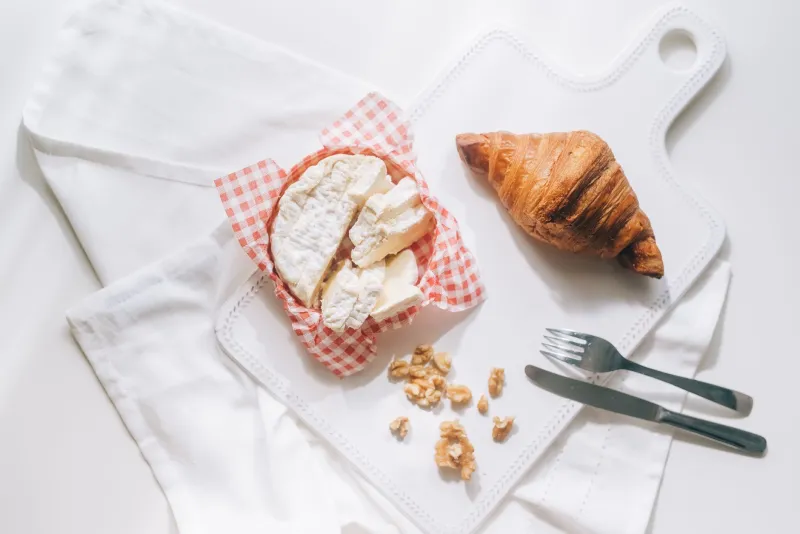
The accompaniments matter, and the French keep them simple. Good bread — a sourdough, a walnut loaf, or a plain baguette — is essential. Crackers are fine, but bread is better; it doesn't compete. A few walnuts. Perhaps a small pot of quince paste or a drizzle of honey alongside the blue. A handful of grapes if the season allows.
What you don't need: chutney in a jar, oatcakes from a cardboard sleeve, or anything that brings its own strong flavour. The cheese is the point. Everything else is support.
Making It a Habit
You don't need to be hosting a dinner party to bring the French cheese course into your life. On a Friday evening, after a simple supper, try pulling together three small pieces of cheese from whatever you have in the fridge, a bit of leftover bread, and a glass of whatever red you've been drinking. Serve them before the chocolate or the yoghurt or whatever you'd normally call dessert. Notice how the meal feels different — more complete, more considered, more like an occasion.
That feeling is what the French have been quietly cultivating for generations. And the good news is, it's available to anyone willing to rethink the order of things.