Less on the Board: Why the French Approach to Charcuterie Is More Satisfying Than Britain's Pile-It-High Trend
At some point in the last five years, the charcuterie board became a British competitive sport. You know the one. The enormous slate or reclaimed-wood plank, groaning under the weight of three types of salami, a full wedge of brie, grapes (always grapes), some kind of jam in a tiny jar, crackers in four varieties, cornichons spilling over the edge, dried apricots, honeycomb, and what appears to be an entire wheel of camembert balanced precariously at one end.
It looks spectacular in photographs. It photographs beautifully on Instagram. It also, fairly reliably, results in about £40 of food that half gets eaten, a quarter gets picked at, and the rest sits out too long and gets binned. But it made an impression, which in the current entertaining culture seems to be the primary goal.
France has a different view.
The French Principle of Enough
Walk into a French bistro and order a charcuterie maison or an assiette de charcuterie, and what arrives will almost certainly surprise you with its modesty. Three or four thin slices of something excellent — perhaps a good rosette de Lyon, a few ribbons of jambon de Bayonne, a small pile of rillettes beside a couple of slices of toast. A small dish of cornichons. Maybe a handful of olives if the place is feeling generous. A few slices of proper bread.
That's it. No honeycomb. No dried mango. No artfully placed sprig of rosemary as decoration.
The first reaction, for a British eye trained on the abundance board, is that this looks a bit thin. The second reaction — once you've actually eaten it — is that it was exactly right. You tasted everything. Nothing overwhelmed anything else. The jambon was properly appreciated because it wasn't competing with eight other things for your attention. You finished it without waste and felt ready for whatever came next.
This is what the French mean by la juste quantité — the right amount. Not stinginess. Not austerity. Just the discipline to serve what's needed rather than everything available.
Why Abundance Boards Fail on Their Own Terms
The irony of the maximalist charcuterie board is that it actually delivers less pleasure per item than its more restrained French equivalent, despite costing significantly more to assemble.
When there are fifteen things on a board, your attention is constantly divided. You graze rather than taste. You eat a bit of this, a bit of that, without really focusing on anything long enough to appreciate it. The excellent Manchego gets lost next to the brie, which gets obscured by the crackers, which are competing with the grapes. Everything cancels everything else out.
There's also the waste problem, which is more significant than most people admit. Charcuterie and cheese left out at room temperature for two to three hours during a long evening — as typically happens with a grazing board — deteriorates noticeably. Sliced cured meats dry at the edges. Soft cheese weeps and loses its texture. The beautiful board you photographed at 7pm looks considerably less beautiful by 9:30pm, and a meaningful portion of it ends up in the bin.
The French approach sidesteps this entirely. Because you serve less, you serve what will actually be eaten. What doesn't go out doesn't spoil.
Curation Over Accumulation
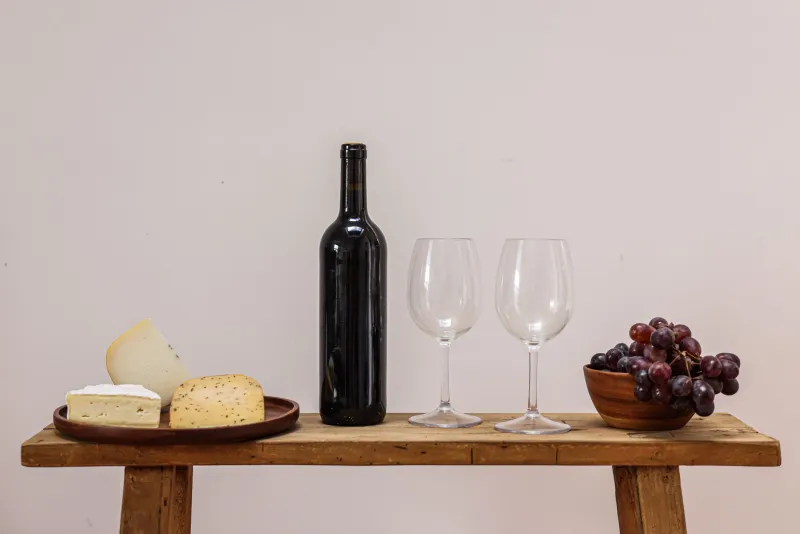
The skill in the French approach isn't restraint for its own sake — it's curation. Choosing three or four things that genuinely work together rather than assembling everything that might conceivably belong on a board.
A good French-style charcuterie selection asks a few simple questions. What's the quality of each item? Are the flavours complementary rather than repetitive? Is there textural variety? Does the accompaniment serve the food rather than distract from it?
Cornichons are not decorative. They're acidic and crunchy, and they cut through the fat of a rich pâté or the salt of a cured ham in a way that makes both taste better. A small pot of Dijon mustard alongside a slice of saucisson sec isn't a styling choice — the mustard lifts the pork and balances the spice. These are considered pairings, not Pinterest aesthetics.
The bread matters too. In France, good bread is non-negotiable — a baguette that's been properly made, perhaps a few slices of a dense country loaf. Not water crackers, not rice cakes, not the kind of crispbread that shatters into shards the moment you apply any pressure. Bread that can carry the food without dissolving into crumbs.
What This Means for Entertaining at Home
Shifting to a more French approach to pre-dinner charcuterie doesn't require a wholesale reinvention of how you entertain. It just requires a change in the question you're asking when you plan it.
Instead of asking what can I put on this board, ask what three or four things are genuinely excellent right now, and what do they need alongside them.
A good independent deli — the kind that's been quietly thriving in British towns for years — can help with this. Ask what's good this week. Buy less of it than you think you need. Serve it at the right temperature (cured meats benefit from sitting out of the fridge for twenty minutes before serving; cheese needs longer). Provide proper bread. Put the cornichons in a small bowl rather than scattering them across the board.
The result will be less visually dramatic. It will also be more genuinely enjoyable, less wasteful, and cheaper — which feels like a reasonable trade.
The Bigger Question
Britain's current entertaining culture is, in many ways, driven by social performance — the desire to impress, to demonstrate generosity, to create something photographable. These are human impulses and not entirely to be dismissed. But somewhere in the pursuit of the abundant board, we've conflated quantity with quality and spectacle with hospitality.
The French approach to charcuterie is a useful corrective because it insists, quietly but firmly, that the point of putting food on a table is for people to eat it and enjoy it — not to admire it, not to photograph it, and certainly not to leave half of it behind.
Less on the board. More in the experience. That's a French idea worth borrowing.