Order Something. Stay a While. The Lost Art of Actually Being in a Café
There's a moment, about ten minutes into sitting at a pavement table in any French town, when something strange happens. You stop feeling like you should be doing something else. The mild anxiety that follows most British people through their day — the sense that stillness is somehow suspect — quietly dissolves. You watch a man argue gently with a pigeon over a croissant crumb. You notice the light change. You order a second coffee not because you need the caffeine but because leaving feels wrong.
This is not a small thing. This is the entire point.
What a Café Is Actually For
The French café, at its best, is a civic institution. It's where you go not just to drink something warm but to be present in the world in a low-stakes, pleasurable way. Regulars are known by their order, not their name. The waiter doesn't hover. Nobody slides a card reader across the table the moment you've drained your cup. The implicit agreement between café and customer is simple: you are welcome here, and you may stay.
That agreement has been almost entirely dismantled in Britain. Walk into most high-street coffee chains on a Tuesday morning and you'll encounter a very different social contract. Queues engineered for throughput. Names shouted over industrial milk-steaming. Seating designed to be uncomfortable after twenty minutes. And everywhere, the quiet pressure to consume and vacate — to treat the whole transaction as a pitstop rather than a destination.
This isn't entirely the customer's fault. The infrastructure of British coffee culture has been built around speed and volume. We've been trained to see a café visit as something to be completed rather than experienced.
The Ritual Matters More Than the Drink
In France, the act of sitting down in a café follows a loose but recognisable sequence, and the sequence itself carries meaning. You arrive. You choose your table with some care — near the window, perhaps, or at the edge of the terrace where the street is visible. You wait to be acknowledged, which is not the same as being ignored. You order something specific, not from a menu of forty-seven variations but from a short list of things the café actually does well. An express, a noisette, a crème. A glass of something sparkling if it's past noon and you feel like it.
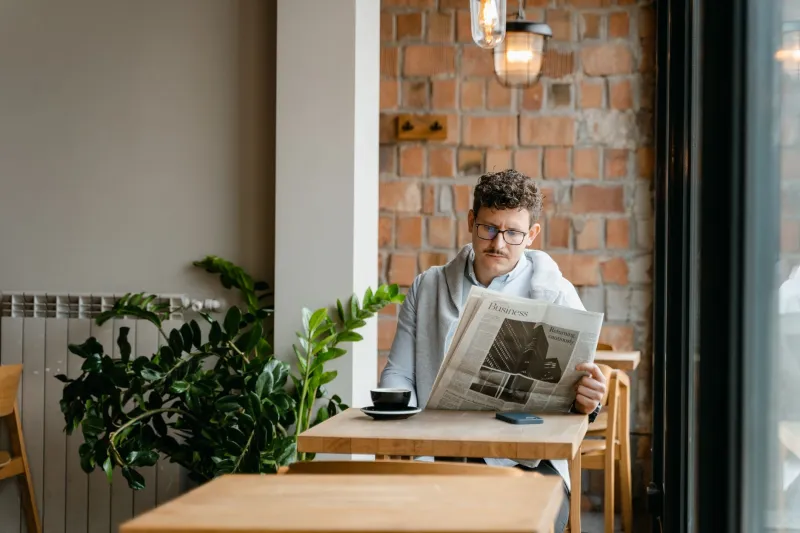
Then you simply... occupy the space. You might read. You might write a few lines in a notebook. You might watch the street. Crucially, you are not expected to perform productivity. Nobody is filming a meeting here. Nobody is hot-desking with a laptop and a set of noise-cancelling headphones, making the café into a remote office while ordering one oat flat white every three hours.
The phone stays in the pocket. Or at least, it's not the first thing you reach for.
Why Britain Traded This In
The British relationship with public leisure has always been slightly complicated. There's a cultural discomfort with being seen to do nothing — a Protestant residue, perhaps, or just decades of being told that busyness equals worth. The lunch hour shrank. The tea break became a desk ritual. And when the café boom arrived in the nineties and early two-thousands, it was reframed almost immediately as a productivity tool: somewhere to work, to meet, to catch up, to fuel yourself for the next thing.
The drink became incidental. The stay became guilty. The ritual vanished entirely.
What's been lost isn't just a pleasant hour here or there. It's a whole practice of being at ease in public space — of understanding that a café is not a service point but a place with its own quiet culture, its own rhythm, its own implicit invitation to slow down.
Reclaiming the Sit-Down
You don't need to move to Lyon to get this back. You need, mostly, to make a decision.
Choose a café that isn't built around volume. Independent places, neighbourhood spots, the kind of room where the espresso machine looks like it's been there since the nineties and the chairs don't have a forty-five-minute time limit written on a sign near the door. Sit somewhere that feels deliberate. Order something you actually want, not just the most efficient thing. And then — this is the hard bit — put your phone away for the first fifteen minutes.
Notice what happens in the room. Notice the other people. Notice the quality of the light. Notice that you are, for this small window of time, not required to be anywhere else or be anyone in particular.
This is what French café culture has always understood: the value of a visit is not in the coffee. It's in the pause the coffee gives you permission to take. Britain used to know this too — the tea room, the milk bar, the corner café with its formica tables and unhurried atmosphere. The bones of that culture are still here. They just need someone to sit down in them again, properly, without apology.
One Table, No Agenda
At Le Café Anglais, we think about this a lot. The French half of our identity is built on exactly this principle: that a café should feel like an arrival, not a transaction. That the table is yours for as long as the coffee lasts. That the person behind the counter knows the difference between a customer who wants to be left alone and one who wants to chat, and respects both equally.
The British half of us knows how hard that is to pull off on a grey Wednesday in November, when the queue is out the door and everyone's late for something.
But we try. Because the alternative — a culture where every café visit is just another errand — isn't really a café culture at all. It's just hot drinks with better branding.
So next time you find yourself in a seat with a cup in front of you and nowhere urgently to be: stay. Order something else. Watch the street. The world will still be there when you're done.